

Mapping a County's Real Information Ecosystem as Traditional News Declines
As traditional local journalism thinned out in one Pennsylvania county, we mapped the 97 sources that residents actually rely on now.

The Center for Community-Engaged Media (CCEM) at Temple University's Klein College of Media and Communication studies how communities get their news, especially as traditional local journalism declines. It came to us with a question that's playing out in suburban counties across the country: when the daily paper shrinks and no newsroom fully covers a place anymore, who actually keeps residents informed?
The setting was Delaware County, Pennsylvania, a large, diverse suburb of Philadelphia known locally as "Delco." Its legacy daily paper, founded in the 1870s, had been hollowed out by ownership cuts, leaving a vacuum where professional local coverage used to be. Something had rushed in to fill it, but nobody had a clear picture of what that something actually was. CCEM needed that picture: a rigorous, comprehensive map of the county's real information ecosystem, not the one that existed on paper twenty years ago.
You can't study, support, or strengthen an information ecosystem you can't see. And Delco's had become genuinely hard to see. The old model was legible: a daily paper, a couple of radio signals, some weeklies. The new one was the opposite of legible. News now surfaced first in volunteer-run Facebook groups, neighborhood pages, activist accounts, hyperlocal newsletters, community podcasts, and the feeds of individual "influencer journalists," most of whom had no formal newsroom behind them and no reason to appear on any official media list.
That created a real research problem. These carriers are scattered across platforms, often private or semi-private, frequently run by one person in their spare time, and constantly appearing and disappearing. There's no directory. A missing-person alert might reach thousands through a community Facebook group hours before any official release, and residents treat it as authoritative, but that carrier is invisible to anyone studying the county through a traditional media lens.
The challenge, then, wasn't just to list sources. It was to impose a coherent structure on something inherently fragmented: to define what even counts as an "information carrier" in this environment, find them across platforms where they don't announce themselves, and organize the result into something a researcher or organization could actually act on. Fragmentation wasn't a flaw in the landscape to be smoothed over. It was the landscape, and the map had to capture it honestly.
You can't study, support, or strengthen an information ecosystem you can't see. And Delco's had become genuinely hard to see. The old model was legible: a daily paper, a couple of radio signals, some weeklies. The new one was the opposite of legible. News now surfaced first in volunteer-run Facebook groups, neighborhood pages, activist accounts, hyperlocal newsletters, community podcasts, and the feeds of individual "influencer journalists," most of whom had no formal newsroom behind them and no reason to appear on any official media list.
That created a real research problem. These carriers are scattered across platforms, often private or semi-private, frequently run by one person in their spare time, and constantly appearing and disappearing. There's no directory. A missing-person alert might reach thousands through a community Facebook group hours before any official release, and residents treat it as authoritative, but that carrier is invisible to anyone studying the county through a traditional media lens.
The challenge, then, wasn't just to list sources. It was to impose a coherent structure on something inherently fragmented: to define what even counts as an "information carrier" in this environment, find them across platforms where they don't announce themselves, and organize the result into something a researcher or organization could actually act on. Fragmentation wasn't a flaw in the landscape to be smoothed over. It was the landscape, and the map had to capture it honestly.
No existing directory or reliable list of the sources residents actually use
Carriers spread across many platforms, often private, informal, or run by volunteers
A constantly shifting ecosystem where sources emerge and go dormant with little notice
The need to define, consistently, what qualifies as a real "information carrier" in a decentralized environment
Turning an intentionally fragmented landscape into a structured, usable map without flattening what makes it distinctive
We defined the thing before we counted it.
Before mapping anything, we set clear inclusion criteria for what counts as an information carrier: a genuine local focus on the county, active and regular publishing, demonstrated audience engagement, and a real function of sharing news or community information. That discipline is what separated a rigorous map from a random list, and it let us treat a 27,000-member Facebook group and a one-person newsletter as comparable units in the same system.
We searched where the news actually lives.
Rather than start from the official media directory, we ran a multi-phase search built for a decentralized ecosystem: auditing traditional outlets, then systematically mapping social platforms using local geographic and keyword signals, then identifying the individual influencers and activists who function as information hubs, and finally following cross-references from one carrier to the next. That snowball approach surfaced the carriers no official list would ever contain.
We organized fragmentation into structure.
We classified every carrier by topic area and by platform, which turned a sprawling mess into a legible system: you could suddenly see which beats were crowded, which were thin, and which platforms carried the county's attention. That structure is what made the ecosystem understandable and, crucially, actionable.
The research identified 97 active information carriers serving Delaware County, and that number alone reframed the client's question. The county wasn't a news desert. It was a dense, participatory, and highly fragmented ecosystem where the work of keeping people informed had been redistributed across dozens of small, mostly volunteer-run channels.
We organized those carriers into a clear map of the county's information ecosystem, sorted by topic cluster and platform type, so the shape of the landscape became visible at a glance.
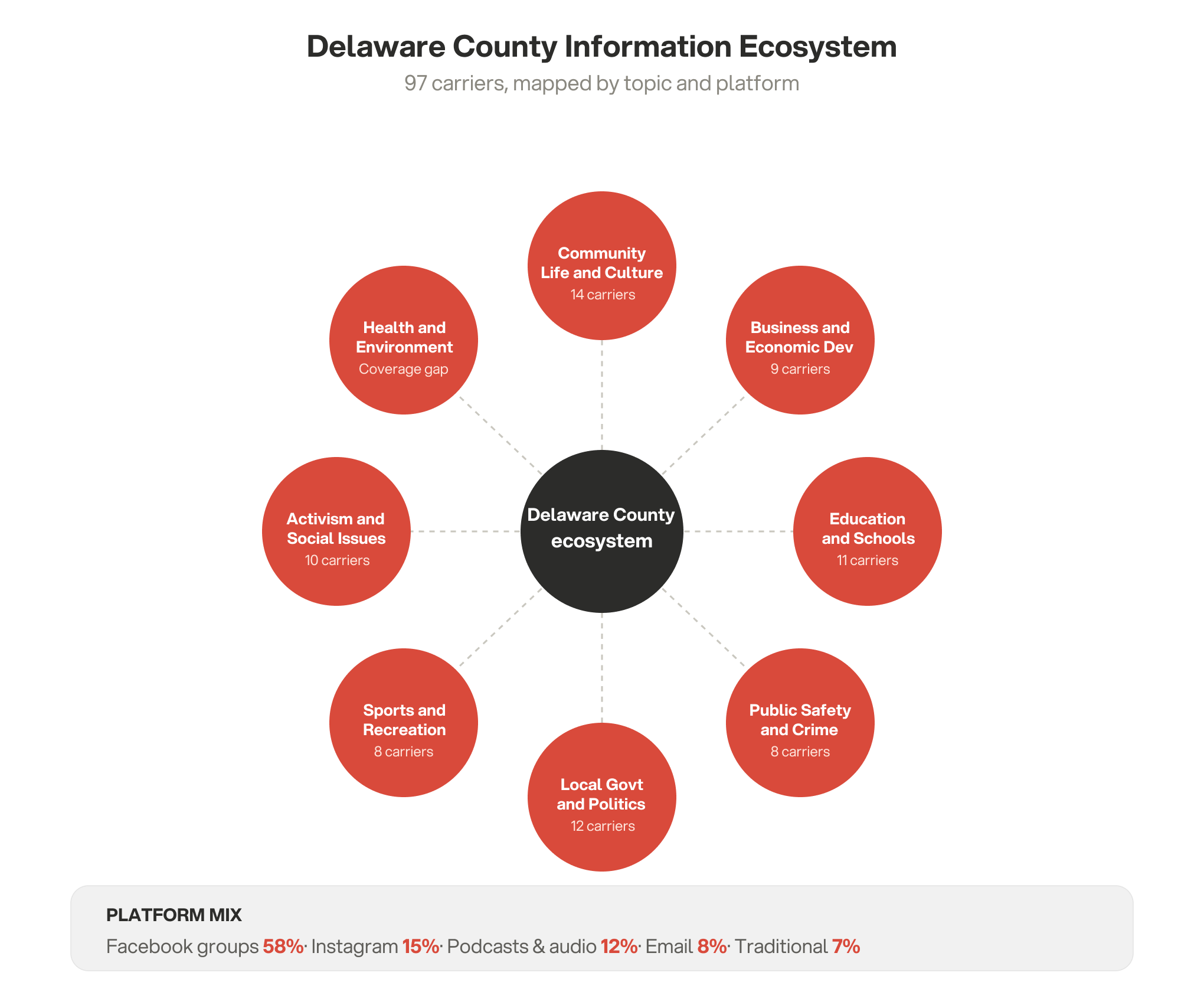
Two findings jumped out of that structure. First, the sheer dominance of Facebook: well over half of all carriers operated primarily through Facebook groups and pages, making it the county's de facto public square, far ahead of Instagram, podcasts, email newsletters, or what remained of traditional media. Second, the topic map revealed exactly where the ecosystem was strong and where it was thin. Community life, local government, and education were densely covered by grassroots carriers, while areas like investigative accountability reporting, multilingual coverage for a growing immigrant population, and youth-oriented news sat in real coverage gaps, the beats most likely to fall through when volunteers, not newsrooms, carry the load.
Beyond the map, we translated the landscape into a practical playbook for engaging it. We documented how information actually flows by topic, who the most influential carriers are in each area, and, importantly, how to reach them: which carriers respond to email, which expect a genuine relationship before any ask, and which are unpaid volunteers whose time has to be respected. We paired that with a clear-eyed account of the ecosystem's structural risks, the accountability gap left by the loss of professional watchdog reporting, the neighborhoods and smaller municipalities that fall off the information grid entirely, and the way alarming news can now spread faster than verified context.
Because this engagement delivered a diagnostic map rather than a single recommendation, the measures reflect the scope of what we made visible and how usable it is.
The most useful thing we was making an invisible system legible. When a county's journalism thins out, it's tempting to call the result a news desert and move on. What the map showed instead was something more interesting and more hopeful: a dense, participatory ecosystem doing real informational work, just redistributed into places traditional analysis never thinks to look.
Seeing that clearly changes what's possible. You can't strengthen coverage gaps you haven't found, or reach a community through carriers you don't know exist. By turning a fragmented landscape into a structured, honest map, we gave a research institution the foundation to do both, and a way to understand where local information is thriving, where it's failing, and who's really holding it together now.