

The STEPP Framework: Creator Partnerships That Protect Trust
A discipline for building creator partnerships that extend an institution's reach without spending its credibility.
July
17

By Adriana Lacy
.jpg)
Audiences increasingly place their trust in individual creators rather than in institutions, and they do so before they ever encounter an institution's own channels. For the foundations, universities, nonprofits, and newsrooms now racing to work with creators, this shift creates a specific risk: partnerships built to extend an institution's reach can quietly erode the credibility they were meant to protect. This paper introduces the STEPP Framework, a discipline developed by Adriana Lacy Consulting and grounded in five commitments, Standards, Transparency, Engagement, Platform-Native content, and Public Service. Forged in journalism, where the stakes for trust are highest, and now applied across institutions of every kind, STEPP offers a practical model for partnering with creators without spending the trust that makes those partnerships worth building.
Why most creator partnerships fail before they begin
Most institutions approach content creators as a distribution problem. They have a message, a creator has an audience, and the partnership is imagined as a pipe connecting the two. This is the mistake that quietly undermines the majority of creator collaborations, and it undermines them for a specific reason. Audiences do not follow creators for their reach. They follow them for their trust. The moment a partnership treats a creator as a channel rather than a relationship, it begins to spend the very thing that made the creator valuable.
The stakes of getting this right have grown sharply, and the data now describes a genuine shift in where public trust lives. As of 2025, about one in five U.S. adults regularly gets news from influencers on social media, rising to 38% of adults ages 18 to 29, according to Pew Research Center. Trust has moved alongside that behavior. Pew finds that only 56% of Americans express even some trust in national news outlets, down eleven points in a single year, while among adults under 30, trust in information from social media now roughly equals trust in national news organizations.
The most telling figure for any institution considering this work concerns affiliation. Pew’s landscape study found that 77% of prominent news influencers have no current or past affiliation with a news organization, and a majority of the audiences who rely on them believe that independence is precisely the point. Trust is flowing toward voices that sit outside institutions, and often because they sit outside them.
This is the environment every mission-driven institution now operates in. Audiences increasingly extend their trust to individual voices rather than to organizations, and they do so before they ever encounter an institution’s own channels. Foundations, universities, public health agencies, and newsrooms face the same question. Not whether to work with creators, but how to do so without hollowing out the credibility the partnership was meant to extend.
That question does not have an intuitive answer, which is why so many partnerships stumble. The organizations that succeed are not the ones that spend the most or reach the widest. They are the ones that bring discipline to a space that rewards authenticity and punishes anything that feels transactional. STEPP is the framework we developed for exactly that purpose.
Why journalism is the proving ground
We developed STEPP in journalism because journalism is the hardest place to get creator partnerships right. When a newsroom’s credibility is its entire reason for existing, there is no room for a partnership that blurs the line between trusted reporting and paid promotion. The editorial standards that have guided journalism for generations, verification, disclosure, independence from commercial influence, meet an ecosystem built on personality, algorithm fluency, and audience intimacy. The friction between those two worlds is real, and it is unforgiving. A partnership that mishandles it does not just underperform. It damages the credibility of both parties.
A framework that protects trust under those conditions is, by construction, robust enough for environments where the stakes are real but less absolute. That is the logic of this paper. The principles were forged where the margin for error was smallest, which is exactly why they generalize.
STEPP is not static theory. It is currently being applied through a funded cohort of five newsrooms across the country, each using the framework to vet creators, structure agreements, and build partnerships from the ground up. A detailed case study of that work will follow this paper. What we have already seen confirms the framework’s central premise: the newsrooms that treated their creators as professional partners, and brought real rigor to the selection, consistently built stronger collaborations than the instinct to simply find someone with a large following would have produced.
The five pillars of STEPP
STEPP runs every partnership through five commitments. Each addresses a specific way that creator collaborations tend to go wrong, and each is stated as a discipline rather than a rule, because the work is judgment, not compliance.
.png)
S — Standards
The counterintuitive part of Standards is that upholding them makes creators more valuable, not less. Institutions often worry that editorial rigor will strip a creator of the authenticity that drew their audience. In practice, the opposite holds. A creator whose factual claims are verified, whose past content has been reviewed for alignment, and who operates inside a clear corrections process is a creator an institution can stand behind publicly. Standards are what make the partnership defensible when it is questioned, and creator partnerships are questioned.
In practice, Standards means factual claims in collaborative content meet the institution’s own bar for verification, even as the creator retains their voice and opinion. It means vetting a creator’s history before a partnership begins, not after a controversy. And it means establishing, up front, who is accountable when something is wrong and how it gets corrected.
T — Transparency
The reflex many institutions have is to downplay a partnership, on the theory that disclosure makes it seem less authentic. The evidence points the other way. Research on creator partnerships consistently finds that clear disclosure does not diminish credibility when the relationship is genuine and the alignment is real; audiences penalize the concealment, not the partnership. Nearly three in four consumers now say brands and creators share responsibility for ensuring sponsored content is truthful and transparent.
Transparency means the nature of a collaboration is visible to the audience in plain language, that the existence of a financial relationship is acknowledged even where amounts are not, and that opinion is labeled as opinion. Disclosure is not a risk to be managed. It is a signal of respect that audiences increasingly expect and reward.
E — Engagement
Engagement is the pillar that most separates partnerships that last from campaigns that flare and fade, and it rests on a single distinction: broadcasting is transactional, building is relational. That framing is not ours alone. The 2026 Edelman Trust Barometer reached the same conclusion, with Edelman’s own head of creator marketing advising institutions to work with trusted voices who need not have mass followings, to go niche, and to “build alongside them” rather than broadcast a message through them. In a climate of contracting trust, relationships carry more weight than impressions.
Engagement means approaching creators as partners rather than vendors, investing in understanding their work and audience before proposing a deliverable, offering value beyond compensation, and building for the long term. One-off collaborations rarely earn the trust needed to meaningfully extend an institution’s reach.
P — Platform-Native
Platform-Native content acknowledges that the creator understands their platform and audience better than the institution does, and that this expertise is the point of the partnership. Content that thrives on TikTok will not translate unchanged to a newsletter or a website. The instinct to impose an institutional voice, format, and structure on a creator’s work produces exactly the inauthenticity that makes audiences disengage.
In practice, Platform-Native means adapting format while protecting substance, preserving the creator’s voice as the asset it is, and trusting their read on timing, structure, and what their community responds to. The institution owns accuracy and standards. The creator owns the craft of reaching people.
P — Public Service
Public Service anchors the entire framework in purpose. Every partnership should have a clear answer to a single question: how does this serve the audience, not just the institution? When the only answer is “it extends our reach” or “it builds our brand,” the partnership has lost its center. This is the pillar that keeps a creator collaboration from quietly becoming a marketing exercise wearing the language of mission.
Public Service means prioritizing partnerships that help communities access information or resources they need, reaching audiences an institution has historically underserved, and measuring success by impact rather than reach alone. The question is not how many people saw it. The question is what they were able to do because they did.
Beyond the newsroom: STEPP for any mission-driven institution
Journalism was the proving ground, but it is not the boundary. The institutions arriving in the creator economy have grown numerous, and as they mature in the work, they independently reach for the same principles STEPP codifies.
The scale is no longer marginal. In the most recent M+R Benchmarks study, 58% of nonprofits reported working with outside creators to promote their content in 2025. The composition of that work is as telling as the volume. Among nonprofits running influencer programs, 87% worked with mid-sized accounts of 10,000 to 100,000 followers, and only a quarter worked exclusively with paid creators; the large majority blended paid and unpaid, relationship-based partnerships. In other words, the field is already discovering, at scale, that fit beats reach and that relationships outperform transactions. Those are STEPP’s Engagement and Platform-Native pillars, learned the hard way, one organization at a time.
Independent guidance for these institutions now emphasizes vetting creators for mission alignment over follower count, granting creative freedom while holding standards, building long-term relationships, and writing contracts with disclosure requirements and takedown provisions for misinformation. Read that list against the five pillars and the overlap is near-total. STEPP is not being stretched to fit these institutions. It names a discipline they are converging on regardless.
The framework translates directly:
- For a foundation funding a creator campaign on a public issue, Standards means vetting a creator’s track record on accuracy before a grant is attached to their voice, and Public Service means the campaign is measured by whether communities acted on better information, not by impressions alone.
- For a university reaching prospective students, Transparency means being clear about what is a genuine student voice and what is a compensated partnership, a distinction younger audiences detect quickly and penalize when it is hidden.
- For a public health or civic organization, the framework becomes a defense against a documented risk. Creators are as capable of amplifying misinformation as of countering it, and audiences increasingly trust peers and individual voices over institutions on exactly the questions where accuracy matters most. Standards and Engagement together are what separate a creator who becomes a trusted messenger from one who becomes a liability.
In every case the underlying discipline is identical. Start from the mission and the audience rather than the creator’s follower count. Protect credibility as the non-negotiable. Treat the creator as a professional whose authenticity is the asset. The context changes. The framework does not.
Assessing your institution against STEPP
Before launching creator partnerships, an institution should assess its readiness honestly across each dimension. The questions below are a starting point, and a candid set of answers tends to reveal where the real work lies, which is more often internal than external.
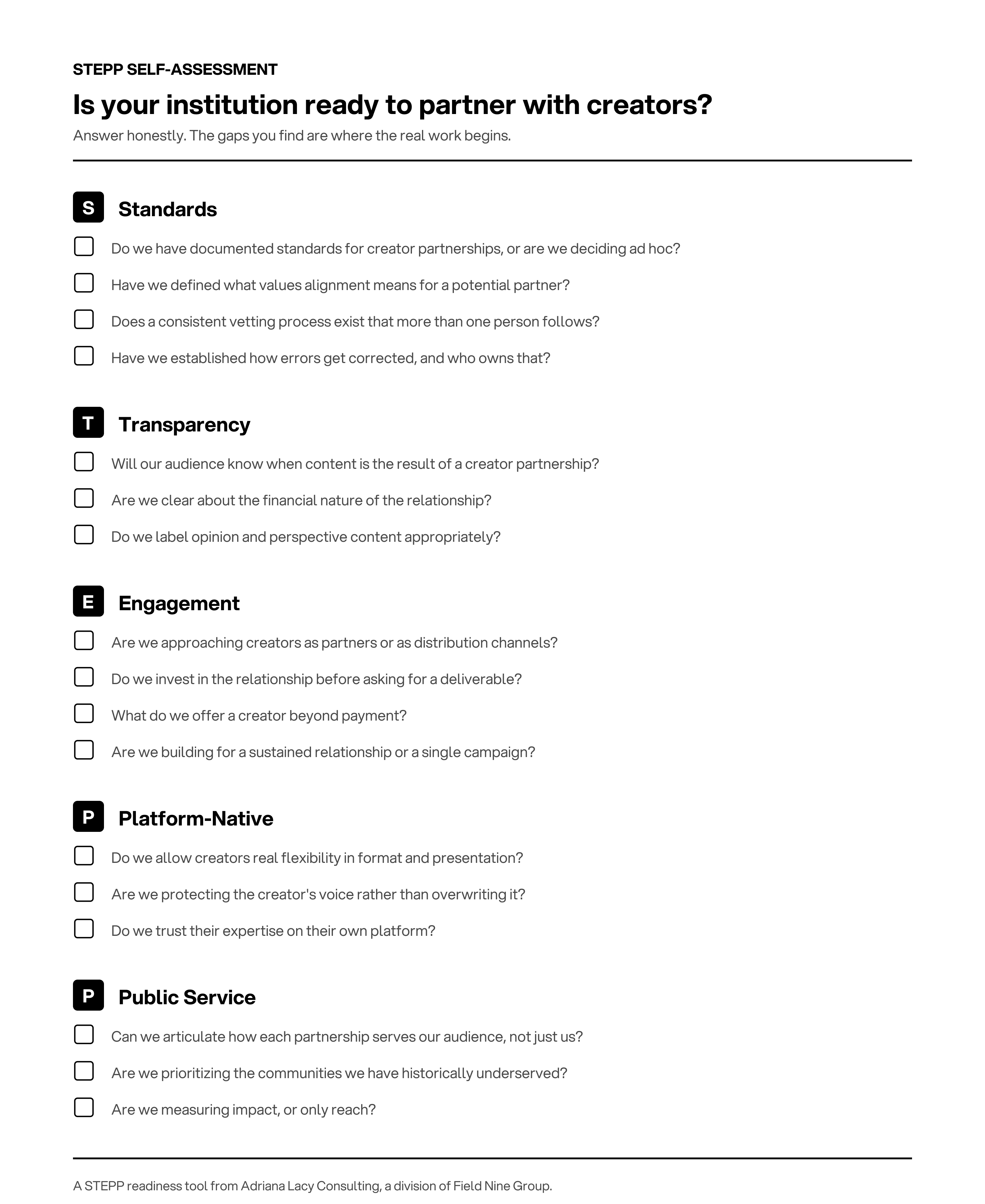
Standards
- Do we have documented standards for creator partnerships, or are we deciding ad hoc?
- Have we defined what values alignment means for a potential partner?
- Does a consistent vetting process exist that more than one person follows?
- Have we established how errors in collaborative content get corrected, and who owns that?
Transparency
- Will our audience know when content is the result of a creator partnership?
- Are we clear, internally and externally, about the financial nature of the relationship?
- Do we label opinion and perspective content appropriately?
Engagement
- Are we approaching creators as partners or as distribution channels?
- Do we invest in the relationship before asking for a deliverable?
- What do we offer a creator beyond payment?
- Are we building for a sustained relationship or a single campaign?
Platform-Native
- Do we allow creators real flexibility in format and presentation?
- Are we protecting the creator’s voice rather than overwriting it?
- Do we trust their expertise on their own platform?
Public Service
- Can we articulate how each partnership serves our audience, not just our institution?
- Are we prioritizing the communities we have historically underserved?
- Are we measuring impact, or only reach?
The mistakes STEPP is built to prevent
Across our work, the failures of creator partnerships fall into a small number of recognizable patterns. Each maps to a pillar, and each is avoidable.
- Treating creators as distribution channels. The transactional “share our content with your audience” approach ignores what makes a creator valuable and offers them little in return. Engagement reframes the partnership as genuinely two-way.
- Forcing creators into an institutional voice. Imposing your format and style produces content that reads as inauthentic and defeats the collaboration’s purpose. Platform-Native protects the voice that earned the audience.
- Skipping due diligence on alignment. Partnering in haste with a creator whose history conflicts with your values invites credibility damage for both sides. Standards puts the vetting before the partnership, not after the problem.
- Hiding the partnership. Concealment, not disclosure, is what erodes trust. Transparency treats disclosure as an asset.
- Measuring only reach. Views and follower growth can obscure whether the work actually served anyone. Public Service anchors evaluation in impact.
- One-off campaigns instead of sustained relationships. Single collaborations rarely build the trust that meaningfully extends reach. Engagement orients toward the long term.
How we think about this work
The creator economy is not a threat to institutions built on trust. It is the environment in which that trust is now won or lost. Audiences have moved their attention and their confidence toward individual voices, and they will continue to. The institutions that thrive will not be the ones that resist this shift or the ones that chase it without discipline. They will be the ones that bring the same rigor to a creator partnership that they bring to everything else they put their name on.
That is what STEPP provides: a way to enter this space with judgment rather than instinct, and to build partnerships that extend an institution’s reach precisely because they protect its credibility. The framework was forged in journalism, tested in the field, and built to travel. The question facing institutional leaders is no longer whether to work with creators. It is whether that work will strengthen the trust they depend on or quietly spend it.
You cannot borrow a creator's trust. You can only build a partnership worthy of it. The institutions that treat creator work as a discipline, not a distribution channel, are the ones that extend their reach without spending their credibility.
Edelman. (2026). 2026 Edelman Trust Barometer. https://www.edelman.com/trust/2026/trust-barometer
M+R. (2026). M+R Benchmarks 2026: Social media & influencers. https://mrbenchmarks.com/social-media-influencers/
Pew Research Center. (2024). America's news influencers. https://www.pewresearch.org/journalism/2024/11/18/americas-news-influencers/
Pew Research Center. (2025). News influencers fact sheet. https://www.pewresearch.org/journalism/fact-sheet/news-influencers-fact-sheet/
Pew Research Center. (2025). Young adults and the future of news. https://www.pewresearch.org/journalism/2025/12/03/young-adults-and-the-future-of-news/
The STEPP Framework is the proprietary framework of Adriana Lacy Consulting, a division of Field Nine Group. It was first developed and applied through Influencer Journalism, Field Nine's creator-newsroom practice.





Stay updated on our latest research
Subscribe to receive insights and publications delivered to your inbox