

Understanding the Next Generation of Science Readers
AAAS wanted to grow News from Science among early-career researchers, so we surveyed and interviewed this audience, benchmarked five competitors, and turned what we learned into a concrete engagement and subscription playbook.

The American Association for the Advancement of Science (AAAS) is one of the largest general scientific bodies in the world, and its news arm, News from Science (NFS), sits alongside the flagship Science journal as a public-facing source of research coverage. AAAS came to us focused on a specific slice of its readership: early-career researchers, or ECRs. These are the graduate students, postdocs, and newly independent scientists who represent both the future of the scientific community and the future of any science publication's subscriber base.
The question was one many mission-driven publishers are quietly asking. A generation of readers is forming its news habits right now, across platforms and formats that look nothing like the ones that built the outlet's existing audience. If NFS wanted to still matter to these researchers in ten years, it needed to understand them now: what they read, where they find it, what they will pay for, and what would make them stay.
The difficulty here wasn't a shortage of good intentions. It was that ECRs are a genuinely hard audience to see clearly. They are time-poor, spread across institutions and countries, active on a shifting mix of platforms, and, crucially, they consume science news alongside a dozen competing sources rather than through any single loyal relationship. A publisher can know its own traffic numbers and still have almost no view into how a young researcher actually decides what to read on a given morning.
There was also a candor problem worth naming. It's tempting, when studying your own most engaged readers, to hear what you hope to hear. The honest challenge was to gather real signal, including inconvenient signal, and to be clear-eyed about how much weight that signal could carry. This was a targeted, qualitative study, not a large representative survey, and the value would come from treating it that way: as a rich, directional read on a specific community, not a statistical mandate.
The difficulty here wasn't a shortage of good intentions. It was that ECRs are a genuinely hard audience to see clearly. They are time-poor, spread across institutions and countries, active on a shifting mix of platforms, and, crucially, they consume science news alongside a dozen competing sources rather than through any single loyal relationship. A publisher can know its own traffic numbers and still have almost no view into how a young researcher actually decides what to read on a given morning.
There was also a candor problem worth naming. It's tempting, when studying your own most engaged readers, to hear what you hope to hear. The honest challenge was to gather real signal, including inconvenient signal, and to be clear-eyed about how much weight that signal could carry. This was a targeted, qualitative study, not a large representative survey, and the value would come from treating it that way: as a rich, directional read on a specific community, not a statistical mandate.
Reaching a busy, dispersed audience whose engagement with any one outlet is shallow by default
Consuming science news through many competing sources, making NFS's real position hard to isolate
Distinguishing genuine preferences from what a friendly, already-engaged audience assumes the client wants to hear
Drawing usable strategy from a deliberately small, qualitative sample without overstating what it proves
Translating scattered habits and preferences into concrete product, content, and subscription moves
We combined methods so no single view carried too much weight.
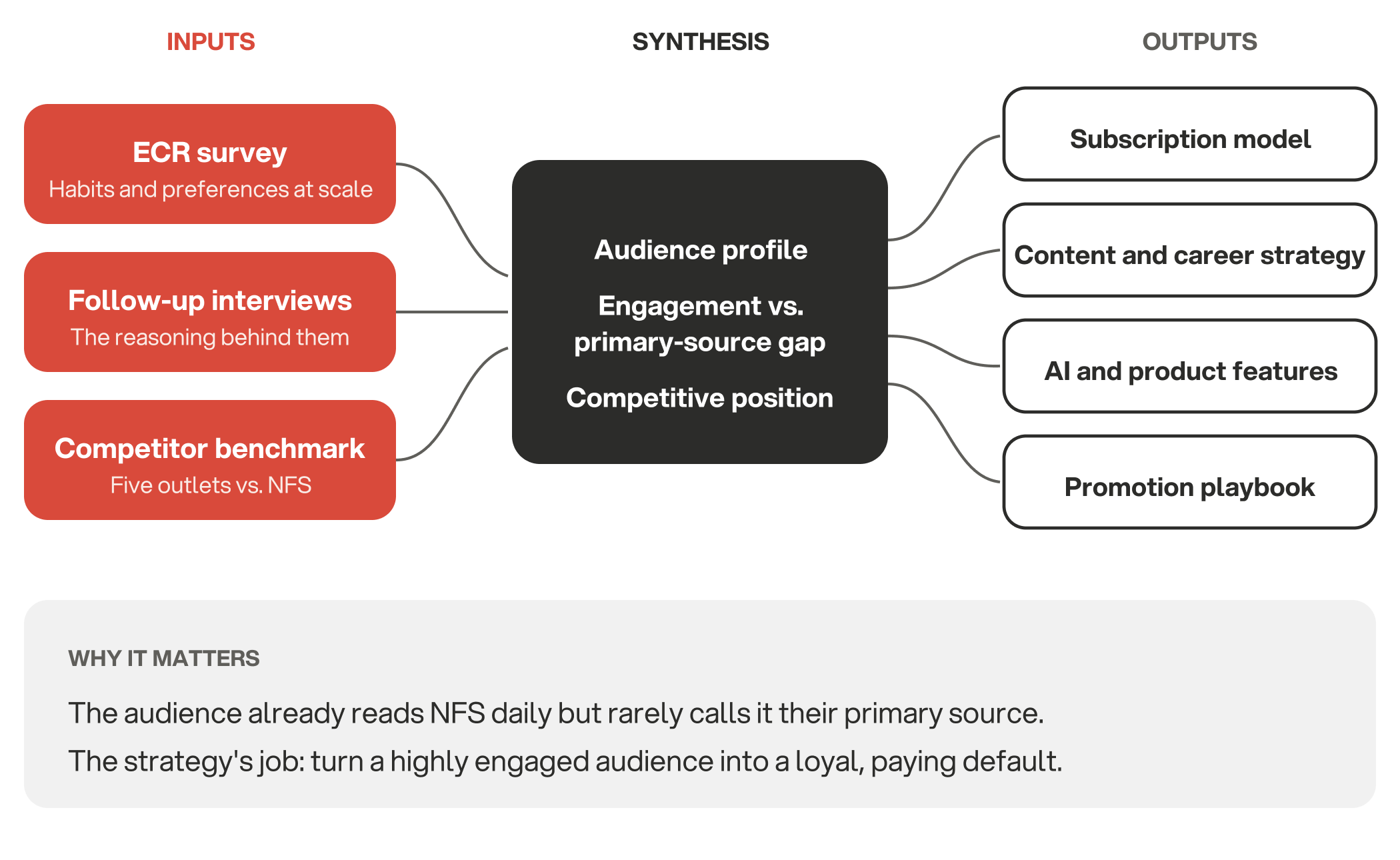
Rather than lean on one instrument, we ran a survey, follow-up interviews, and a structured competitor benchmark in parallel. The survey gave us patterns across the group, the interviews gave us the reasoning behind those patterns, and the competitive analysis told us where NFS actually stood in the field. Each method covered the others' blind spots, which mattered especially given the sample size.
We were honest about the sample from the start.
We were transparent that this was a small, self-selected group who had already agreed to be contacted, and we framed the findings as indicative rather than representative throughout. That discipline is what let the study be useful: instead of dressing up a modest sample as proof, we treated it as a strong qualitative signal from an engaged core, and made recommendations that were robust to that limitation.
We benchmarked against the real competitive set.
We profiled the outlets ECRs actually named, from specialist science publications to a major general-news science section, and mapped each one's strengths against NFS's. That turned a vague sense of "we have competition" into a specific picture of where NFS was differentiated, where it was being out-served, and which gaps were open to move into.
We turned insight into a concrete, prioritized playbook.
The deliverable wasn't a findings deck that ended at "here's what we learned." We carried every insight through to a specific recommendation, spanning the subscription model, content strategy, product features, site navigation, and cross-platform promotion, so AAAS had actions rather than observations.
The research produced a clear portrait of the ECR reader, and several findings pointed in directions AAAS could act on immediately.
The first was engagement paired with a positioning problem. A strong majority of respondents read NFS content daily, yet only a small fraction named it as their primary source for science news, with more established specialist outlets holding that top spot. That gap, between high habitual use and low primary-source loyalty, became the strategic centre of the whole study. NFS wasn't struggling to be read; it was struggling to be the reader's default.
The second was a clear content signal. Career development emerged as the single most wanted content type, named by two-thirds of all respondents and by nearly all current subscribers, alongside a consistent appetite for long-form, in-depth analysis over breaking alerts. Interviewees deepened this, describing a preference for coverage with historical context, cultural range, and richer visuals. That pointed to a specific, underserved opening: career-focused content and analysis, tuned to a generation of researchers who, the wider data suggests, change roles often and are actively navigating their careers.
The third was a set of practical friction points and levers. Price was the one reason given for cancellations, which reframed affordability as a growth lever rather than a footnote. The subscription path on the site was hard to find and routed users toward broader membership rather than the more affordable, ECR-appropriate NFS plan. And the audience's platform behaviour, concentrated on a handful of channels, showed exactly where promotion and discovery efforts should focus.
From these, we built the playbook: a clearer and more affordable subscription path, including an email-capture step and gift options modelled on what competitors already do well; a relaunch of career-focused content; AI-assisted features like article summaries and a guided Q&A layer to serve time-pressed readers; cleaner topic navigation; and a targeted cross-platform promotion plan. Each recommendation traced directly back to something the research had surfaced.
Because this engagement delivered an audience diagnosis and a strategy, not a campaign, the measures reflect the depth of what we learned and the concreteness of what we handed over.
The most useful thing we told AAAS wasn't that early-career researchers liked News from Science. It was that they liked it and still didn't think of it first. Naming that gap between genuine daily engagement and primary-source loyalty gave the whole strategy a target: not to win attention NFS already had, but to convert it into the kind of default relationship that survives a generation forming new habits.
What made the work matter was refusing to let a friendly, engaged sample flatter the client into complacency. By combining methods, staying honest about what a small qualitative study can and can't prove, and carrying every insight through to a concrete move, we gave AAAS something more valuable than reassurance: a clear-eyed read on a hard-to-see audience, and a practical path to growing with them rather than being outgrown by them.